On Memorial Day
Taking care of our military is national security

The last time I saw my younger brother, SGT Andrew Nicol, alive was at my wedding. He was dressed in his Army dress greens for the occasion, his Ranger tab and 75th Ranger Regiment scroll proudly displayed. I have a picture of the two of us hugging, and several of the six of us in my family together in front of the same church where his funeral was held a little over a year later. You could already see the signs of war-weariness on his young, 22-year-old face: the residue of four combat deployments etched into features that should have still been carefree. We didn’t talk much that day, nor in the months after, though I did send him a care package when he shipped off on his fifth deployment, this time to Kandahar. I forgot to pack the note I had written for him. It said I love you and I am proud of you, written with the quiet acknowledgment that we hadn’t always seen eye to eye. Having earned his tab and scroll, he was cocky as hell, and he once told me he refused to salute officers who hadn’t earned their rank. I guess that was me, since I was in the Air Force and had “earned” my commission through ROTC (please go ahead and laugh—I am, at the memory). I figured I’d be able to hand him that letter in person. I didn’t get that chance.
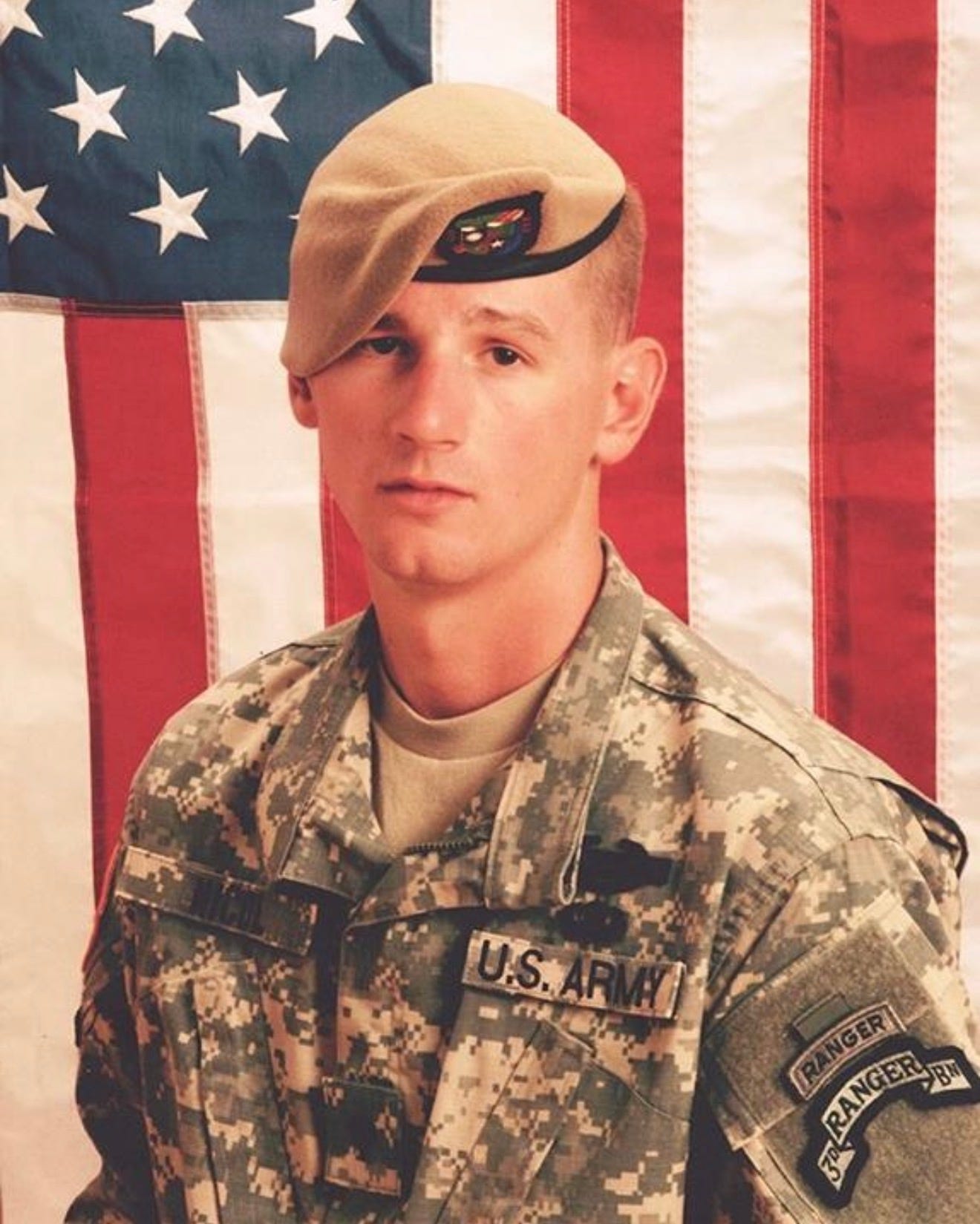
Photo of SGT Andrew Nicol
Looking back, perhaps the work I did after he was killed in action through training as a counterterrorism analyst, learning tactical casualty combat care, and deploying three times to Afghanistan was my attempt to earn that rank in his eyes, at least. His death has shaped me and the last sixteen years of my career, which is to say, most of it. It has compelled me to find ways to keep people safe through sound decisions by our nation: through counterterrorism, through cybersecurity, through software safety, and through a more honest reckoning with what national security actually means and who it is actually meant to protect. Because ultimately I don’t want other families to carry what mine has carried: the particular weight of an early and traumatic death that didn’t have to happen. I am not naive enough to think I can prevent all or even most of it. But I have spent sixteen years believing we can do better. And that belief, I think, is itself a form of honoring him.
What many people don’t know is that my husband Mark’s brother — my would-be brother-in-law, whom I never met — was also killed in action. In Iraq, six years before my brother. His name was also Andrew: a Lance Corporal in the Marines, on his first deployment in 2004. Only six months into dating my now-husband, I witnessed for the first time the way war loss moves through a family and ripples outward across everyone it touches. I also saw bravery and purpose. Mark set aside the military’s sole survivor policy and willingly deployed to both Iraq and Afghanistan. He showed me that I could do the same, which I later did, as a civilian, out of uniform.
On my third and last deployment in 2014, a group of five of us, a civilian, a contractor, and three military (though different branches), became tightly knit. We called ourselves the Wolf Pack for some reason that I can’t remember. We still have a text chain. But one of us, SFC Antonio “Rod” Rodriguez, himself a former 3rd Battalion Ranger, was killed in action in Nangarhar Province in 2020. I still haven’t been able to visit his grave at Arlington Cemetery. His number is still on our text chain.
I am a veteran myself. I have been to war multiple times (sua sponte, if you know what that means) and I know military loss in ways that are both personal and plural. I want to remember all three of these men on Memorial Day, as members of a small but sacred group who gave their lives for their country. Whatever your thoughts of the wars they fought, or their reasons for enlisting, the fact that they went willingly and served bravely deserves acknowledgment with gratitude and reverence. And the families and friends left behind carry that loss every day, often alongside complicated grief and circumstances the rest of us rarely see.
A Nation’s Promise?
Memorial Day is a time to remember and honor the fallen. I also believe it is one of the most important days on our calendar for reckoning honestly with our society’s widening civil-military divide. Not out of guilt, not to compel performative flag-waving or obligatory “thank you for your service,” but as reflection and as sound policy. A strong military, deeply trusted within civil society, is essential to national security. But I am thinking about strength differently than what is on display right now in Washington. I am not referring to gargantuan budgets, to an ever-expanding arsenal, or to a force being reshaped for ideological homogeneity. I am referring to strength through investing in people, both during and after their service. I am referring to the principles of civil-military relations that have made our military one of the most trusted institutions in American life. I am referring to the infrastructure that enables service members to become whole civilians again when their service is done.
Memorial Day asks us to remember the fallen. But remembering them honestly should compel us to ask: what did we ask of them, and what did we promise in return?
We haven’t fully delivered on that promise. One only has to look at the statistics on veteran homelessness and suicide to understand the scale of the gap. Since September 11, 2001, we have asked an extraordinary amount of the all-volunteer force — an historically small percentage of the population bearing the full weight of two prolonged wars without building the commensurate support infrastructure. The human consequences of sustained combat: trauma, identity loss, family strain, the jarring re-entry into a civilian world that barely registered the wars were happening. These challenges don’t resolve on their own, and they certainly don’t resolve without institutional investment. Other nations have done better. Denmark, Canada, and Australia, for example, treat post-combat recovery not as a medical checkbox but as a social, cultural, economic, and civic responsibility, integrating family support, employment transition, psychological care, and long-term follow-up through policy and institutional architecture. These are nations that have decided veteran care is a collective obligation (they’re also nations that invest in other aspects of national security as I’ve defined them in this series: healthcare, education, childcare, etc).
The United States, by contrast, forces veterans to navigate a fragmented maze of government, nonprofit, and private programs as they reintegrate into civilian life. Too many people slip through the gaps. The one substantive federal anchor, the VA medical system is now being actively dismantled. Between January and December 2025, the Trump administration cut nearly 28,000 VA employees which equates to roughly six percent of the agency’s workforce and includes over 2,700 nurses, more than 1,000 medical officers, and over 1,000 psychologists and social workers. More than 1,800 claims evaluators were also eliminated. The loss of physicians alone means an estimated 1.2 million veteran patients have lost their VA provider since early 2025. Clinics have canceled appointments because entire care teams have departed and cannot be replaced due to staffing caps. The administration’s answer is what they call “choice” through routing veterans to private community care providers paid by the VA. But choice is not a substitute for capacity. Community care has documented gaps precisely where post-9/11 veterans need care most: mental health treatment, trauma therapy, rehabilitation. These are not services a private urgent care clinic absorbs on a Tuesday afternoon. They require specialized providers, continuity of care, and the institutional knowledge that comes from decades of focused mission. We should be supplementing a struggling system; instead, we have accelerated its collapse and rebranded the wreckage as reform and efficiency.
What Ash Carter Understood
The late Secretary of Defense Ash Carter knew what real military strength looked like. During his tenure from 2015 to 2017, he set about reframing the concept entirely. His “Force of the Future” initiative focused on talent, retention, and making military service compatible with the full arc of a modern life, implementing policies on parental leave, flexible career paths, and support for military spouses. He opened all combat roles to women, expanding the definition of who can serve and therefore what strength looks like. He advanced LGBTQ+ inclusion to expand the talent pool, and asked that service members be treated as whole people. He invested in suicide prevention and mental health as readiness issues, not peripheral ones, because he understood that an institution’s strength is inseparable from the wellbeing of the people inside it. Carter’s through-line was that the military’s greatest asset is its people, and we must invest in people the way you invest in platforms. This is itself a reframing of national security. National security exists to protect the people of a nation, and it is only as effective as the people who sustain it–the military being an important element of that sustaining force. The current administration has reversed or is actively dismantling most of what Secretary Carter built. What remains is a narrow conception of who belongs in uniform, one that isolates the military further from the civilian population it serves, and ultimately weakens the institution it claims to champion.
I worked for Secretary Carter at the Harvard Kennedy School’s Belfer Center, where he led the Center after leaving government. In one of his last set of remarks before the Fall 2022 semester began, I remember him saying that the Center’s work was to wrestle with hard problems and provide ideas for those in the hot seat. Those words have stayed with me almost four years later. His insistence on treating people as central to military and national strength, the concrete actions he took in service of that belief, and his work shaping how technology could serve public purpose rather than merely private profit or strategic theater have been a model for my own reframing of national security. I don’t think he would like that I am mentioning him alongside the fallen on Memorial Day. I think he would likely prefer I reserve that for the military members themselves. But within the context of this Redefining National Security series, I am respectfully taking the liberty because the work of his life meant so much to so many people, especially military members and their families.
He saw this current crisis coming. In September 2022, he added his name to one of the most remarkable documents in recent American military history: an open letter signed by eight former Secretaries of Defense spanning Republican and Democratic administrations alike, and five former Chairmen of the Joint Chiefs of Staff. Together, they laid out sixteen core principles of healthy civil-military relations: civilian control, lawful orders, mutual trust, the military’s obligation to remain outside partisan politics, and the reciprocal obligation of civilian leaders to honor that boundary. “To Support and Defend: Principles of Civilian Control and Best Practices of Civil-Military Relations” was in effect a collective statement from the entire living leadership of the American military establishment, people whose careers had been built on protecting the institution warning that these principles hold only with vigilance, and that they were under strain. Carter signed it months before his death in December 2022. It was, among other things, one of his final public acts.
What Memorial Day Is Asking of Us
We put flags on their graves. We could also fund their care. We could protect the institution they served from becoming a partisan instrument. We could hold to the principles of civil-military relations that distinguish a constitutional republic from the authoritarian states our military has spent decades opposing. We could demand that the people who send others to fight and die uphold the covenant that gives that sacrifice meaning. We could vote for policies that protect people. Ultimately, I know that we can do better–I know that we can because I’ve seen it. For our military members, our veterans, and, in turn, for our nation.
My brother was 23 years old when he was killed on his 5th tour. Andrew Zabierek was a 26 year old Lance Corporal on his first deployment. Rod Rodriguez was a Ranger who came back from war and then went back again and again. They were people who made a choice that most of their fellow citizens never had to consider. This Memorial Day, 25 years after 9/11, comes at an inflection point for our nation. It’s not asking us to feel grateful or merely plant flags. It is asking us to be worthy of what was given. That is a sacred policy obligation, not merely a passing sentiment. It means building the VA back up instead of gutting it. It means preserving the civil-military norms that protect both the military and the democracy it serves. It also means understanding that a strong military is not measured in dollars or warheads or the ideological purity of its ranks; rather, it is measured in how we take care of the people inside it, and how faithfully we honor the ones we’ve lost. As we look to rebuild our nation in the coming years, and as we look at redefining how we address national security, taking care of our military and our veterans through more sound policy and investment is on the list of vital tasks. When that moment comes, and it will, I’ll be ready to roll up my sleeves once again.